
Device, Cable, and Panel Labeling scheme.
V2 of the Device, Cable, and Panel Labeling scheme. It keeps the V1 content and makes the formats consistent. Items marked PROPOSAL are new rules that need your decision. Items marked UNTESTED have not been checked on a real printer or site. Items marked FIELD are how I actually label on jobs (first example: 919 Stanford, October 2026). Where FIELD and a proposal disagree, FIELD wins.
Scope
How to name and label sites, rooms, panels, patch panels, devices, and cables in my installations. Based loosely on ANSI/TIA-606 (see "Relation to TIA-606" below). Device naming (firewalls, switches, cameras, access control) is my own convention, not part of 606.
General rules
| Rule | Detail |
|---|---|
| Characters | Uppercase letters, digits, - and .&, no /. Lowercase is used only for the suffix letter (see below). IDs have no spaces. FIELD: location lines on a label may use spaces (GARAGE RACK01). |
| Patch panel port | FIELD: P + panel number, dash, port. Example: P1-16 = patch panel 1, port 16. This dash is part of the port ID, not a field separator. |
- (dash) | Separates fields: site, then room or device, then patch panel or role. Example: SASC-IDF.1.01- |
. (dot) | Separates numbers inside one field: floor, door or panel number, port. Example: IDF.1.01 = IDF, floor 1, door 01. SW01.49 = switch 01, port 49. |
| Suffix letter | Lowercase a, b, ... for a second item at the same spot, or the legs of a split cable. Example: SASC-IDF.1.01b, |
| Padding | PROPOSAL. Floor: 1 character. Door, panel, device number, port: 2 digits (01). Cable serial numbers: 3 digits (001). |
| Floors | PROPOSAL. 1 = ground or entry floor, 2, 3 ... above. B = basement (B, then C for a second basement level). |
| Site prefix | Required on room, panel, and device labels. May be left off cable labels when both ends are in the same site (saves label space). |
| Same label both ends | Every cable gets the same label at both ends. A cable label must use the exact device and port names on this page. |
Site codes
PROPOSAL:Short 3code per site: letters, or 4the uppercasestreet letters.number for a building (919 = 919 Stanford). Fill in the table as sites are added.
| Code | Site | Notes | |
|---|---|---|---|
919 | 919 Stanford | Multi-unit residential. See "Multi-unit residential" below. | |
SASC | (fill in) | ||
MHF | Wilson (fill in) | ||
925 | (fill in) | Street |
Rooms, panels, and doors
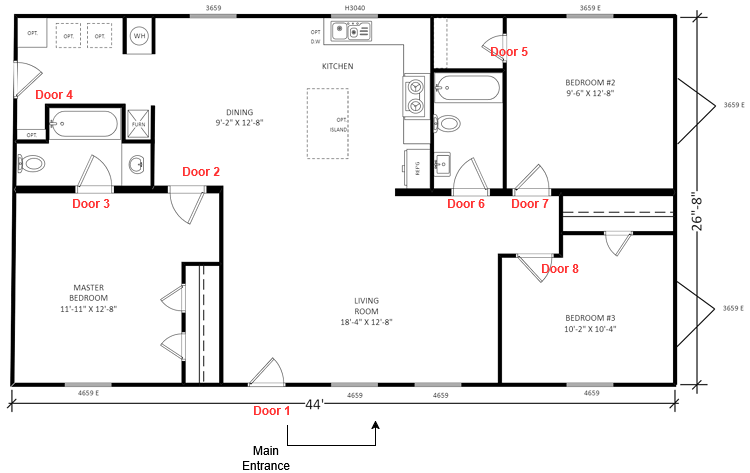
Doors and panels are numbered clockwise, starting at the Main Entry. PROPOSAL: on other floors, start at the stair or elevator nearest the Main Entry.
| Type | Format | Example | Second one |
|---|---|---|---|
| Main Point of Entry (MPOE) | SITE-MPOE.floor.door | SASC-MPOE.1.06 | N/A. One MPOE per site. |
| Intermediate Distribution Frame (IDF) | SITE-IDF.floor.door | SASC-IDF.1.01 | SASC-IDF.1.01b (second IDF behind the same door) |
| Media cabinet / panel | SITE-PNL.floor.number | SASC-PNL.2.01 | SASC-PNL.2.02 |
| Facility door | SITE-DR.floor.door | SASC-DR.1.01 | SASC-DR.1.02 |
| Patch panel (inside a room or cabinet) | P + number, top to bottom | P6 | P7 |
| Patch panel port | | | |
| Port, full name | SITE-ROOM- | SASC-IDF.1.01- |
The patch panel face only needs the short form (P6.P6-12
Notes
MPOE: where the carrier's service enters the building (the demarc). In houses it is often under the stairs or in the basement. In large buildings, riser cables run from the MPOE (or the main equipment room) up to the IDFs on other floors.
IDF: the room or rack on each floor that holds the switches for that floor. It connects back to the MPOE with riser cables.
Device labels
Network and server devices
| Type | Format | Example | Second one |
|---|---|---|---|
| ISP handoff (modem / ONT) | SITE-ISP## | MHF-ISP01 | MHF-ISP02. Put the carrier name (e.g. ATT) in the records, not the label. |
| Firewall / router | SITE-FW## | SASC-FW01 | SASC-FW02 (HA pair: 01 = primary) |
| Aggregation / distribution switch | SITE-AGG## | SASC-AGG01 | SASC-AGG02 |
| Access switch | SITE-SW## | SASC-SW01 | SASC-SW02 |
| Wireless access point | SITE-AP## | SASC-AP01 | PROPOSAL (new in V2) |
| Server / host | SITE-SRV## | SASC-SRV01 | PROPOSAL (new in V2) |
| NAS | SITE-NAS## | SASC-NAS01 | PROPOSAL (new in V2) |
| UPS / PDU | SITE-UPS##, SITE-PDU## | SASC-UPS01 | PROPOSAL (new in V2) |
Cameras
| Type | Format | Example | Second one |
|---|---|---|---|
| Internal camera | SITE-INT-What | SASC-INT-CashReg | SASC-INT-CashReg02 |
| External camera | SITE-EXT-What | SASC-EXT-DrivewayN | SASC-EXT-DrivewayS |
Cameras are named for what they look at. INT and EXT show access level at a glance: tenants and employees can usually see external cameras, but access to internal cameras is tightly controlled. The camera name is the exception to the uppercase rule, so it stays readable.
Access control (physical hardware in panels or on walls)
| Type | Format | Example | Second one |
|---|---|---|---|
| Door access hub | SITE-CTL.floor.door | SASC-CTL.1.05 | SASC-CTL.1.05b |
| Reader-Flex (no hub) | SITE-CTL.floor.door | SASC-CTL.1.01 | SASC-CTL.1.01b |
| Badge reader | (controller)-RDR | SASC-CTL.1.05-RDR | SASC-CTL.1.05-RDRb (second reader, e.g. exit side) |
| Door intercom | (controller)-INT | SASC-CTL.1.05-INT |
The door number in a CTL label is the same as in the door's own label (SASC-DR.1.05 uses SASC-CTL.1.05).
Cable labels
Two-lineEvery wrapcable label,gets the same wrap label at both ends:
Line 1Upstream (top)= upstream end:the end closer to the ISP /core.core) - always comes before downstream.
Structured cable runs (in-wall: rack to unit, rack to outlet, riser)
FIELD. Three-line label:
Line Content Example 1 (large) Cable ID = the patch panel port at the upstream end P1-162 Upstream location (room or rack) GARAGE RACK013 Downstream location (unit or room, and position) UNIT J.02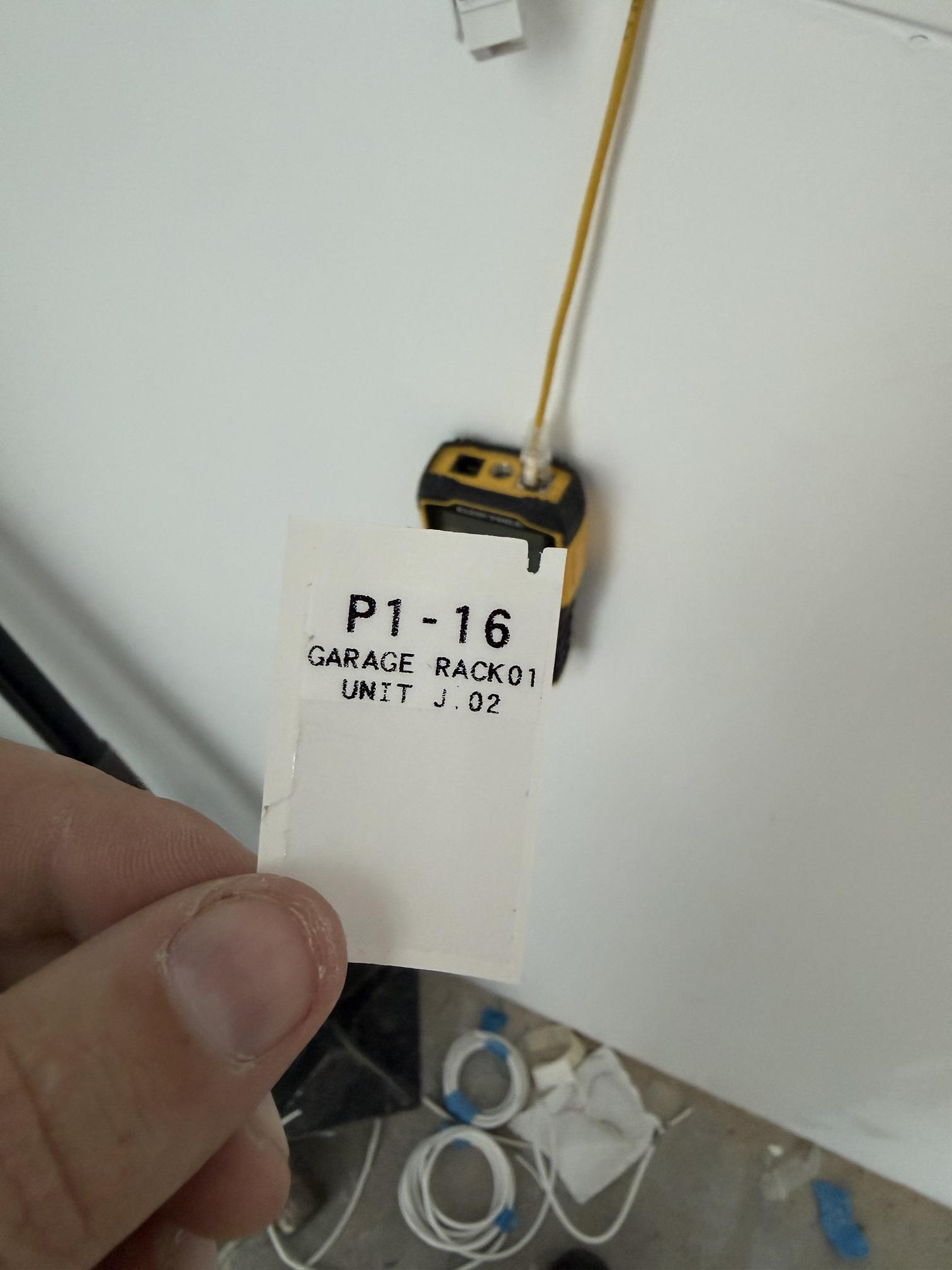
919 Stanford: the cable from garage rack 01, patch panel 1, port 16 to position 02 in the Unit J media panel.
Patch cords between devices
Two-line label. Line 1 = upstream device and port, line 2
= downstream(bottom)end:device and port, using theend closer to the user or device. Each line =deviceornamesport name fromon thispage,page plus.port.
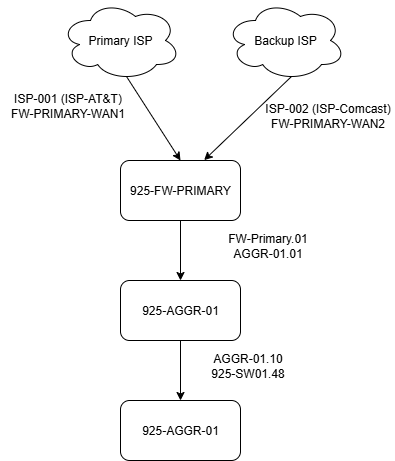
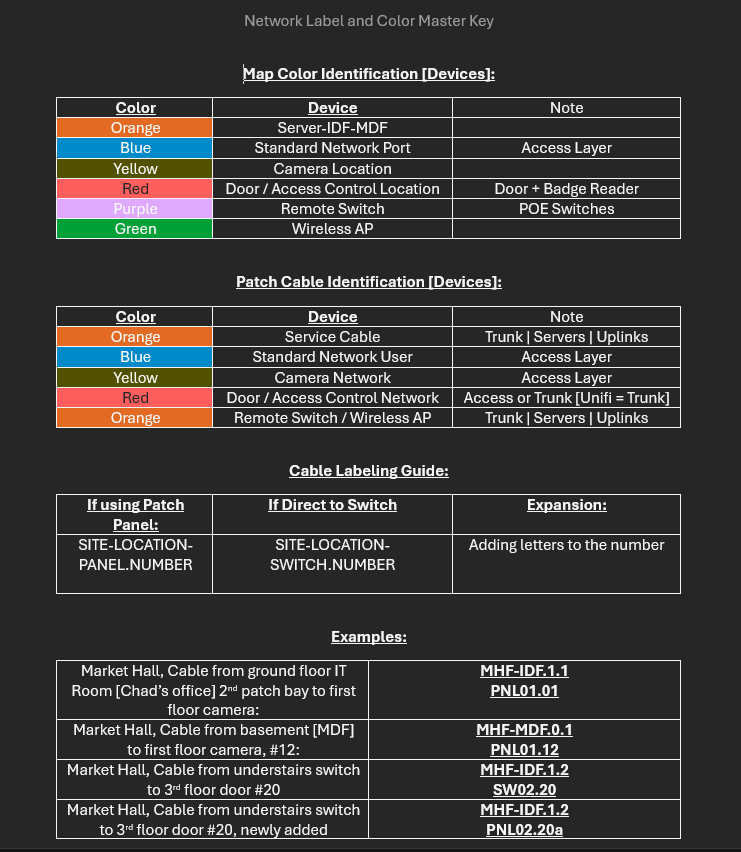
The diagram above is from V1 and may still show V1 formats.
This is different from TIA-606, where the near end is printed first so the order flips at each end. Here the order is always upstream first, so the label reads the same everywhere.
| Cable | Line 1 (upstream) | Line 2 (downstream) | Notes | ||
|---|---|---|---|---|---|
| ISP to firewall | ISP01 | FW01.WAN1 | Second WAN: ISP02 / FW01.WAN2 | ||
| Firewall to aggregation switch | FW01.03 | AGG01.01 | HA: FW02.03 / AGG02.01 | ||
| Aggregation to access switch | AGG01.10 | SW01.49 | Bond / LAG: label each member normally (e.g. AGG02.12 / SW01.49 and AGG02.13 / SW01.50). Record the LAG in the docs. | ||
| Switch to patch panel (patch cord in rack) | SW01.12 | | |||
| Patch panel to wall outlet (horizontal) | Three-line | label: P6-12 / IDF.1. | FL1-WALL. The outlet faceplate shows P6-12. | Split cable: | |
| Riser / backbone (between MPOE, IDFs, panels) | Three-line | label: P1-01 / MPOE.1. / IDF.2.01 | | Add the site prefix if the cable leaves the site. | |
| Building rack to unit media panel | FIELD. Three-line label: P1-16 / GARAGE RACK01 / UNIT J.02 | See "Multi-unit residential". | |||
| Camera | IDF.1.01- or SW01.05 | INT-CashReg | The bottom line is the camera name. | ||
| Access hub to badge reader | CTL.1.05 | CTL.1.05-RDR | Intercom: CTL.1.05 / CTL.1.05-INT | ||
| Switch to access hub / Reader-Flex | SW01.20 | CTL.1.05 | |||
UNTESTED:FIELD: the 919 Stanford label fits one large line (P1-16) and two small lines of up to 13 characters (GARAGE RACK01) on the wrap label, with the clear tail left for laminating. I haveam notassuming checkedthis how many characters fit per line onis the 1.5" x 1.0" wrapM7-31-427 labelstock. Longer lines (M7-31-427).more MPOE.1.06-P1.01is13 15characters) characters.are Print a test label before committing to the riser format.UNTESTED.
Service type (from V1)
V1 used a service prefix on patch cables: NET-001, TEL-001, COM-001. In V2 the panel port ID replaces the serial number. PROPOSAL: show the service with cable color (see Relation to TIA-606) or with a third line on the label. See Open questions.
Multi-unit residential
FIELD, from 919 Stanford. A building rack in the garage feeds a media panel (structured media enclosure) in each unit. The ISP's ONT sits in the unit media panel.
Names
| Item | Format | Example |
|---|---|---|
| Building rack | (ROOM) RACK## | GARAGE RACK01 |
| Patch panel port in the building rack | P#-port | P1-16 |
| Unit | UNIT + unit letter | UNIT J |
| Position in the unit media panel | UNIT (letter).## | UNIT J.02 |
| Room drop (unit panel to a room) | Letter + number, in order: A1, B1, C1 ... | D1 |
| Drop location (small text under or over the ID) | FL#-MOUNT | FL1-WALL, FL2-CEILING, FL1-DRBL |
| Unused jack | BLANK | BLANK |
Unit media panel label strip
Each jack gets an ID (large) and a location (small). Jacks fed from the building rack use the rack port as the ID and GARAGE as the location. Red keystones mark the jacks fed from the garage rack.
| Row | 1 | 2 | 3 | 4 | 5 | 6 |
|---|---|---|---|---|---|---|
| Top | P1-15 GARAGE | P1-16 GARAGE | A1 FL1-DRBL | C1 FL2-WALL | E1 FL3-WALL | BLANK |
| Bottom | GARAGE ISP-G | BLANK | B1 FL1-WALL | D1 FL2-CEILING | BLANK | BLANK |
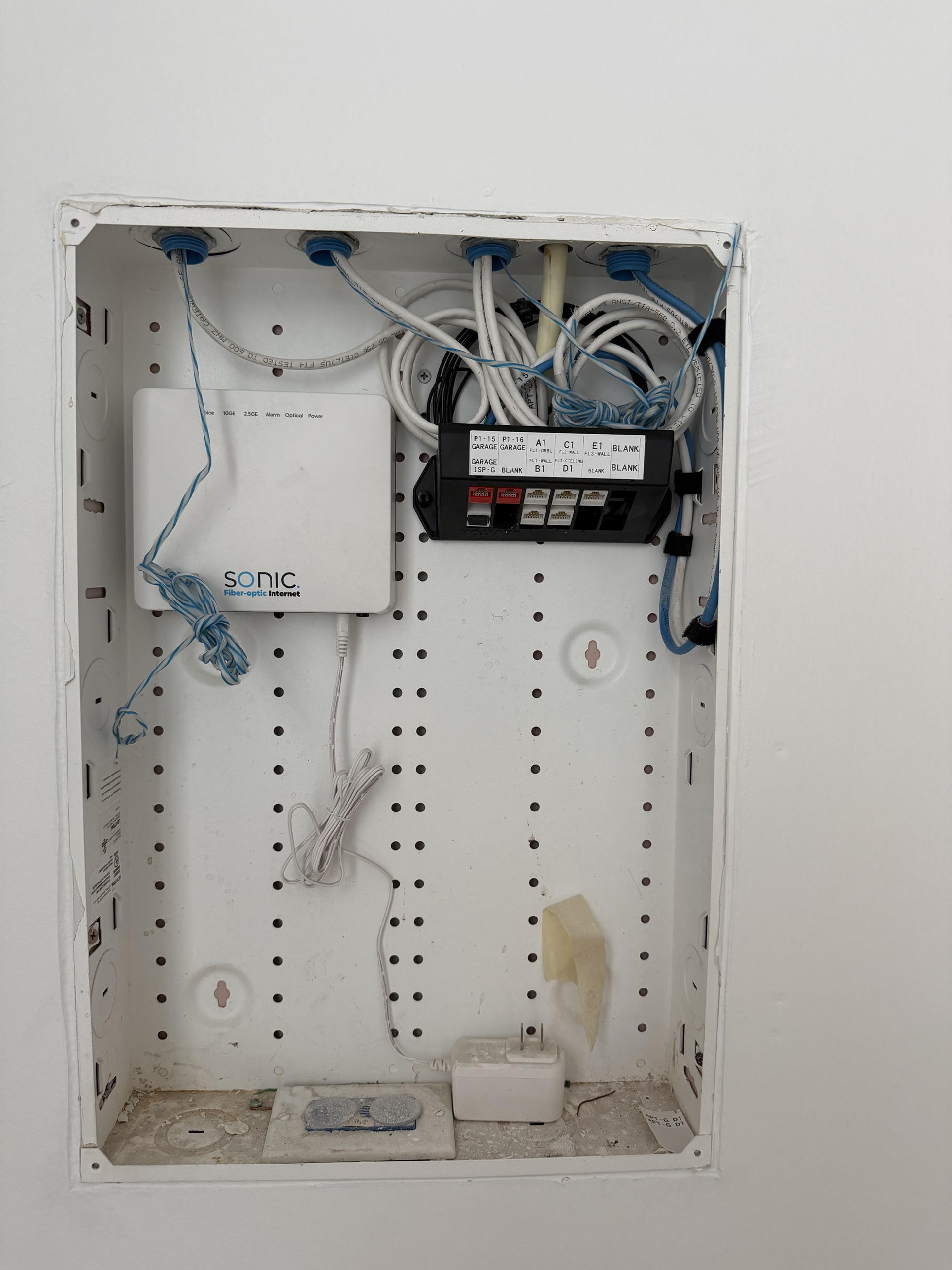
My reading of the photos, not yet confirmed: DRBL = doorbell. ISP-G = ISP feed for unit G. Media panel positions are counted left to right across the top row (so P1-16 is position .02). Room drop letters go down each column, then across. See Open questions.
Hardware and labels
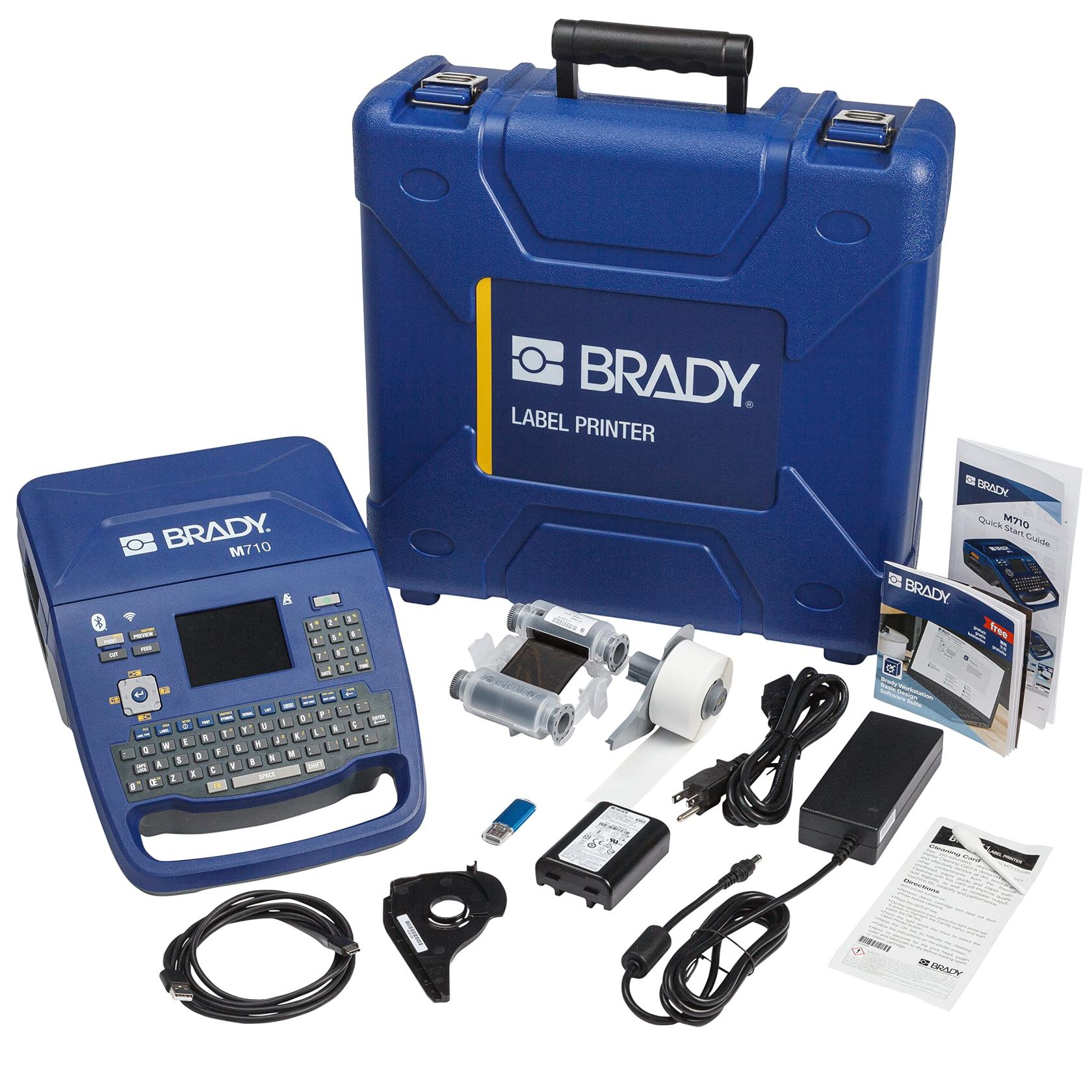
Printer: Brady M710
| Label type | Size | Brady part number | Per roll | Price (V1, date unknown) | Ribbon |
|---|---|---|---|---|---|
| Basic sticker | 1.0" x 1.0" | M7-19-423 | 250 | $43.50 | (fill in) |
| Metallic label | 1.0" x 2.0" | M7-20-435 | 100 | $40.00 | (fill in) |
| Cable wrap (self-laminating) | 1.5" x 1.0" | M7-31-427 | 250 | $68.00 | R4300 ($73.00) |
Templates
Site template (editable): NetworkIdentification.docx
Patch bay label templates:
PatchBaySize_12portLevitonKeystone.docx
PatchBaySize_12portSurfacemount.docx
PatchBaySize_24portKeystone.docx
PatchBaySize_24port.docx
PatchBaySize_48port.docx
These templates were made for V1 formats and may need updating.
Relation to TIA-606
ANSI/TIA-606 is the US cabling administration standard. ISO/IEC 14763-2 is the international equivalent. This scheme borrows its ideas (unique IDs, both ends labeled, records kept) but uses its own formats.
| This scheme | TIA-606 term |
|---|---|
| MPOE | Entrance facility (demarc). Often in the same room as the equipment room / main cross-connect (MDF). |
| IDF | Telecommunications room (TR) |
| Riser cable | Backbone cable |
| Patch panel to outlet | Horizontal link |
| Multi-site with site codes | Class 3 (campus) / Class 4 (multi-site) |
606 color codes (from memory, not checked against the current revision)
| Color | Use |
|---|---|
| Orange | Demarc / carrier |
| Green | Network connections (customer side of demarc) |
| Purple | Common equipment (servers, PBX) |
| White | First-level backbone |
| Gray | Second-level backbone |
| Blue | Horizontal (to the outlet) |
| Brown | Between buildings |
| Yellow | Miscellaneous (security, alarms) |
| Red | Key telephone systems |
606-B cable example (kept from V1)
Near end AG09-35:01/AJ06-35:01, far end AJ06-35:01/AG09-35:01. AG09 = rack at grid AG09, -35 = patch panel 35 rack units from the bottom, :01 = port 1, / = separates near end from far end. Newer revisions (606-C, 606-D) exist. I have not checked what changed.
Changes from V1
| Item | V1 | V2 | |
|---|---|---|---|
| MPOE | SASC-MPO.1.6 | SASC-MPOE.1.06 | |
| IDF second unit | IDF-1-1a | SASC-IDF.1.01b | |
| Doors | SASC-01-DR01 | SASC-DR.1.01 | |
| Firewall on cables | FW-Primary-WAN1 | FW01.WAN1 (same name as the device label) | |
| Aggregation switch | AGG-## and AGGR-## | AGG##, with its own device row | |
| Site 925 devices | 925-FW01 | Same format, but see Open questions about the code | |
| Wilson-MHF patch port | MHF-IDF2.1-P1.1 | MHF-IDF.2.01- (same rule as every site) | |
| Access hub suffix | 1.1A / 1.05a mixed | Always lowercase: 1.05b | |
| Intercom / reader | -IntCom, -Reader | -INT, -RDR | |
| Cameras | INTERNAL-CashReg | SASC-INT-CashReg | |
| Camera cable | SASC-CAM-1.05 | Port ID / camera name | |
| Wire label order | Two conflicting wordings | Upstream | |
| Patch panel port | P6.12 | P6-12 (field practice) | |
| Bond cables | -BONDa / -BONDb | Label each member normally. LAG in the records. | |
| New | General rules, site code table, AP / SRV / NAS / UPS / PDU, patch panel naming, 606 mapping |
Open questions
- Fill in the site code table.
ShouldIs925stay numeric, or getaletterstreetcode?number, like919? - Agree with the separator, padding, and floor proposals?
Line9191Stanford photos: isDRBLthe doorbell? What isISP-G? The media panel photo has anAPT-G D1tag but the cable label saysUNIT J. Which unit is the photo, and should it beUNITorAPT?- Media panel positions: counted across the top row first (so
P1-16=upstream:.02),isorthisdown each column? And what does theorder you actually use1inA1mean: first jack at that location? - Is the
field?919 Stanford label printed on M7-31-427 (1.5" x 1.0")? - Service type: drop
NET/TEL/COM, use cable color, or add a third label line? What didCOMmean? - Are MPOE and MDF always the same room in your sites, or do you need an
MDFroom type? - Do you want rack positions (rack units, as in 606) in the labels, or is
P#top to bottom enough? PrintRiser and outlet labels with lines longer than 13 characters still need a testwrap label to check line length (see UNTESTED note).print.- Ribbon part numbers for the basic and metallic labels.
Related pages
- V1 of this page, saved as a copy ending in "_old" (link to be added)